In October 2026 I spent a few days in Bologna on the way north to Innsbruck, and one of them took me to Palazzo Poggi on Via Zamboni, the old seat of the University of Bologna’s Institute of Sciences. I expected scientific instruments and anatomical wax models. What stopped me instead was a room of manuscripts: Persian poetry, Arabic grammar and a Qur’an, all brought to Bologna three hundred years ago by one restless man.
The building on the title page
The first case explains why any of it is here. One book lies open at its title page: De Bononiensi Scientiarum et Artium Instituto atque Academia Commentarii, printed in Bologna in 1731. According to the label, the series recorded the academic work of the Institute of Sciences between 1731 and 1791, and the copperplate engraving on the title page shows Palazzo Poggi. I was standing inside the building in the picture.
Below it lies the instrumentum donationis, the deed by which Luigi Ferdinando Marsili gave his collection of books and scientific instruments to the Senate and city of Bologna. The label says it is the document that “laid the foundation for the Institute of Sciences”, and that the volume holds an inventory of everything donated and ends with the notaries’ signatures. On the open page I could read the date Die 29. Augusti 1711 in the printed text. On the facing page, next to the handwritten lines, someone had drawn a small tower, which looks like a notary’s sign.
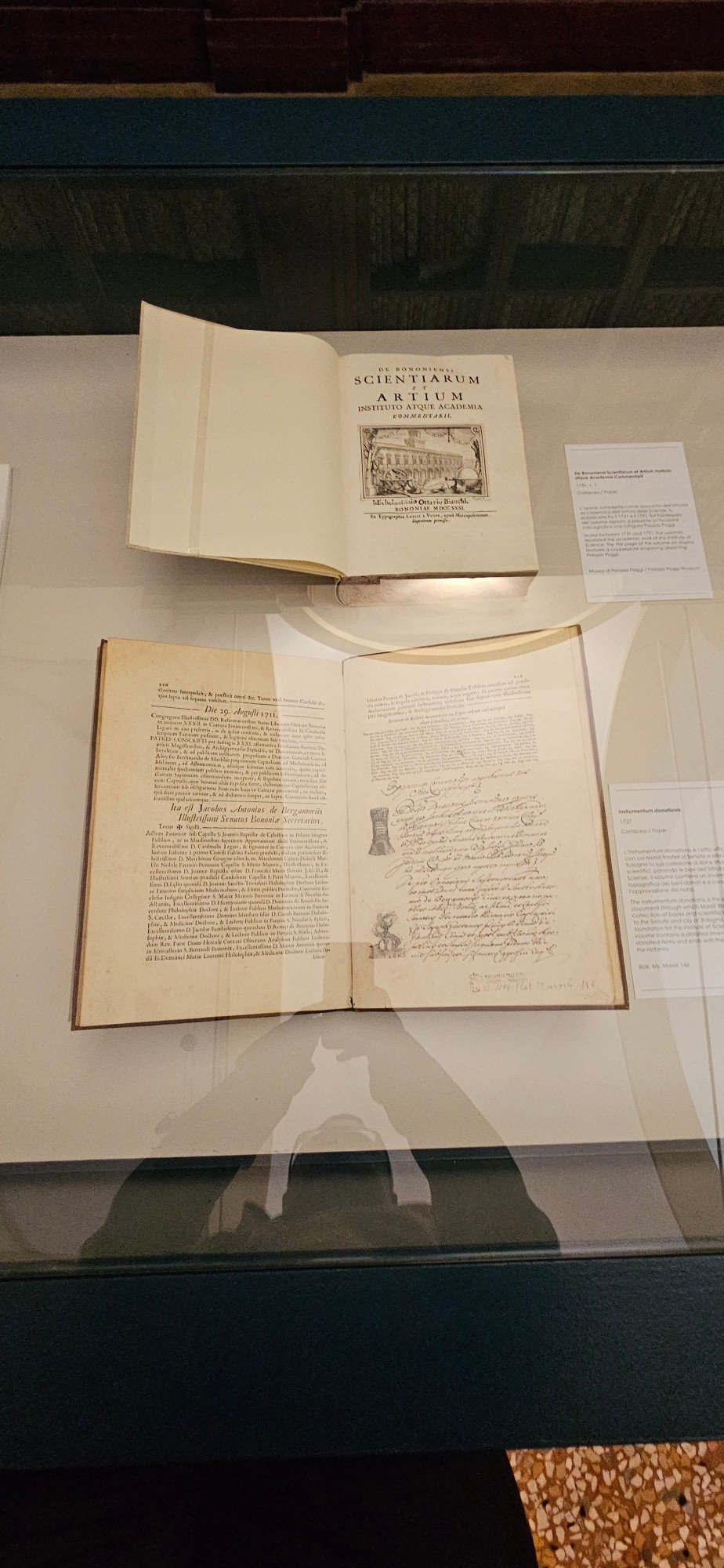 The Commentarii (1731), whose title page shows Palazzo Poggi, above Marsili’s deed of donation.
Marsili (1658–1730) is a strange figure for a founder of a science academy. He was a Bolognese soldier and naturalist. As a young man he went to Constantinople with the Venetian mission in 1679 and collected manuscripts and maps there. In 1683, fighting for the Habsburgs, he was captured, sold as a slave, and held until he was ransomed in March 1684. He later spent years drawing the Habsburg–Ottoman border after the Treaty of Karlowitz. In 1711 the Institute of Sciences was founded on his collections. The Senate bought Palazzo Poggi for it in 1712, and it opened there in 1714. By one count his gift included some nine hundred Oriental manuscripts. A catalogue from 1720 describes them as gathered partly “in the last Turkish war” and partly on a journey to Constantinople.
So the man who had been a prisoner of the Ottomans came home with their books, and he chose to keep them.
A garden that folds
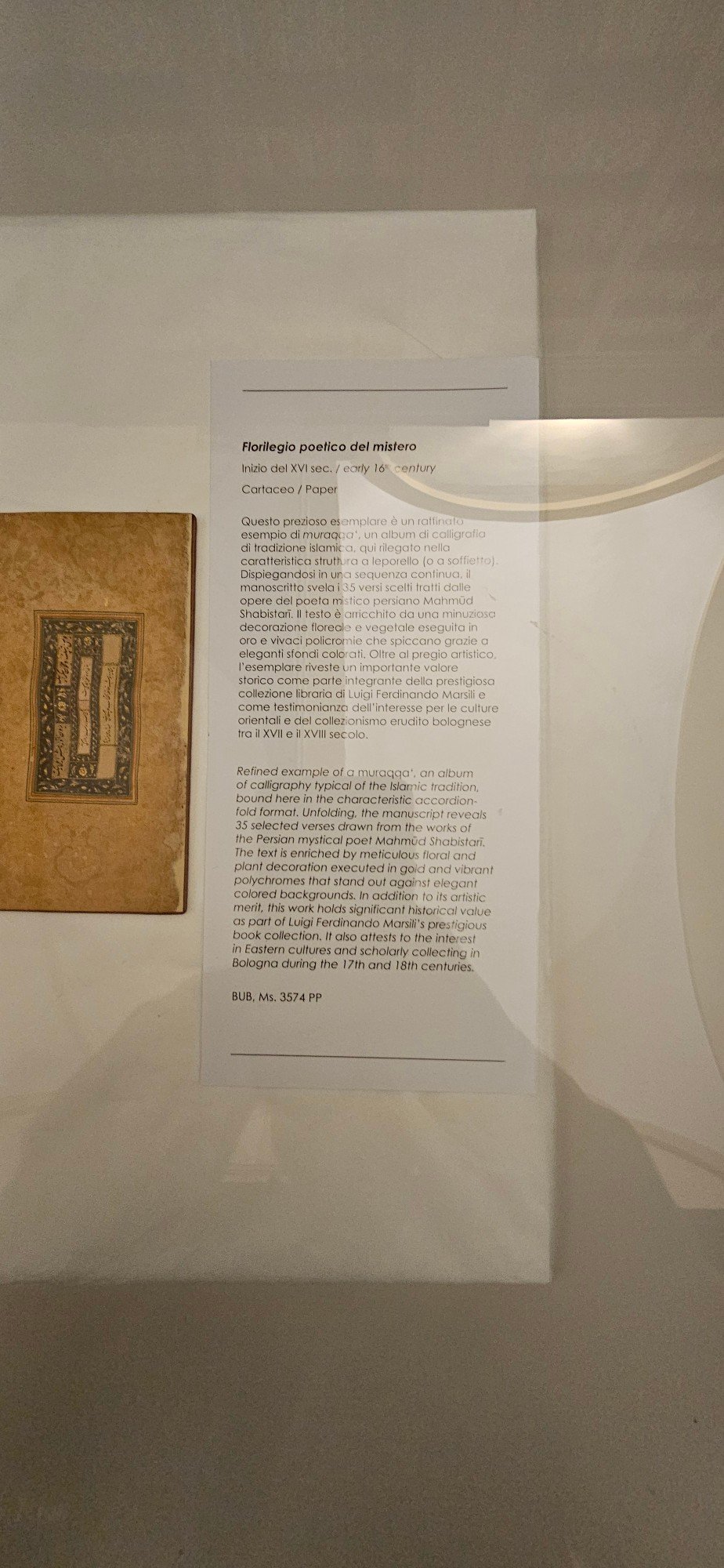
The second case holds what the label calls Florilegio poetico del mistero, early sixteenth century, on paper. Closed, it looks like a small book with a gold-flecked cover and a framed panel of calligraphy. Opened, it is a muraqqa’, an album of calligraphy folded like an accordion. The label says it unfolds to reveal 35 verses from the Persian mystical poet Mahmūd Shabistarī, decorated with “floral and plant decoration executed in gold and vibrant polychromes”, and that it shows “the interest in Eastern cultures and scholarly collecting in Bologna during the 17th and 18th centuries”.
The museum displays it fully unfolded, panel after panel along the length of the case. No two panels are the same colour: salmon, ochre, a deep blue-black, pale rose, each with a framed line of verse in the middle and fine gold vegetation all around. It is a book you walk past rather than read, and it makes the case look like a garden wall.
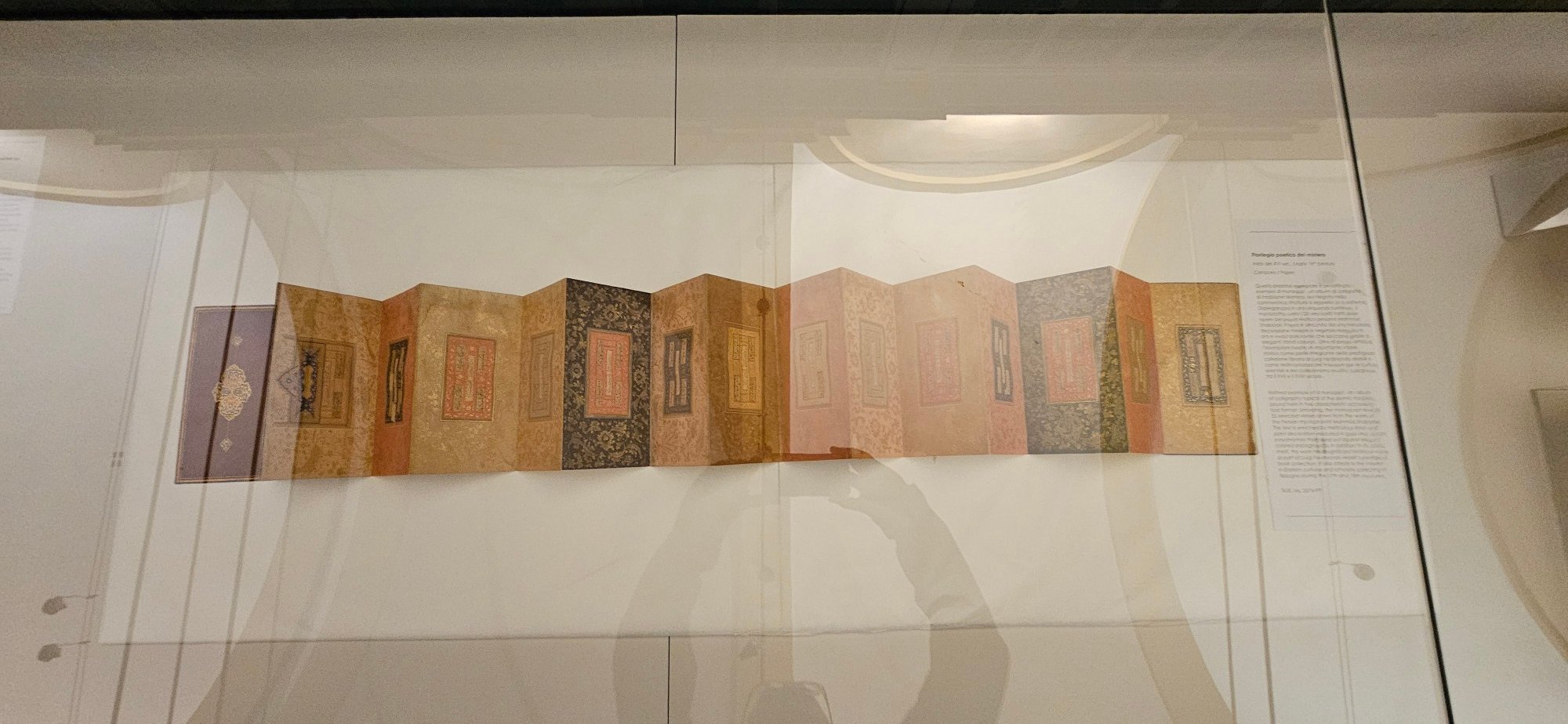 The muraqqa’ opened out. Shabistarī’s verses, one framed panel at a time.
A grammar book with crowded margins
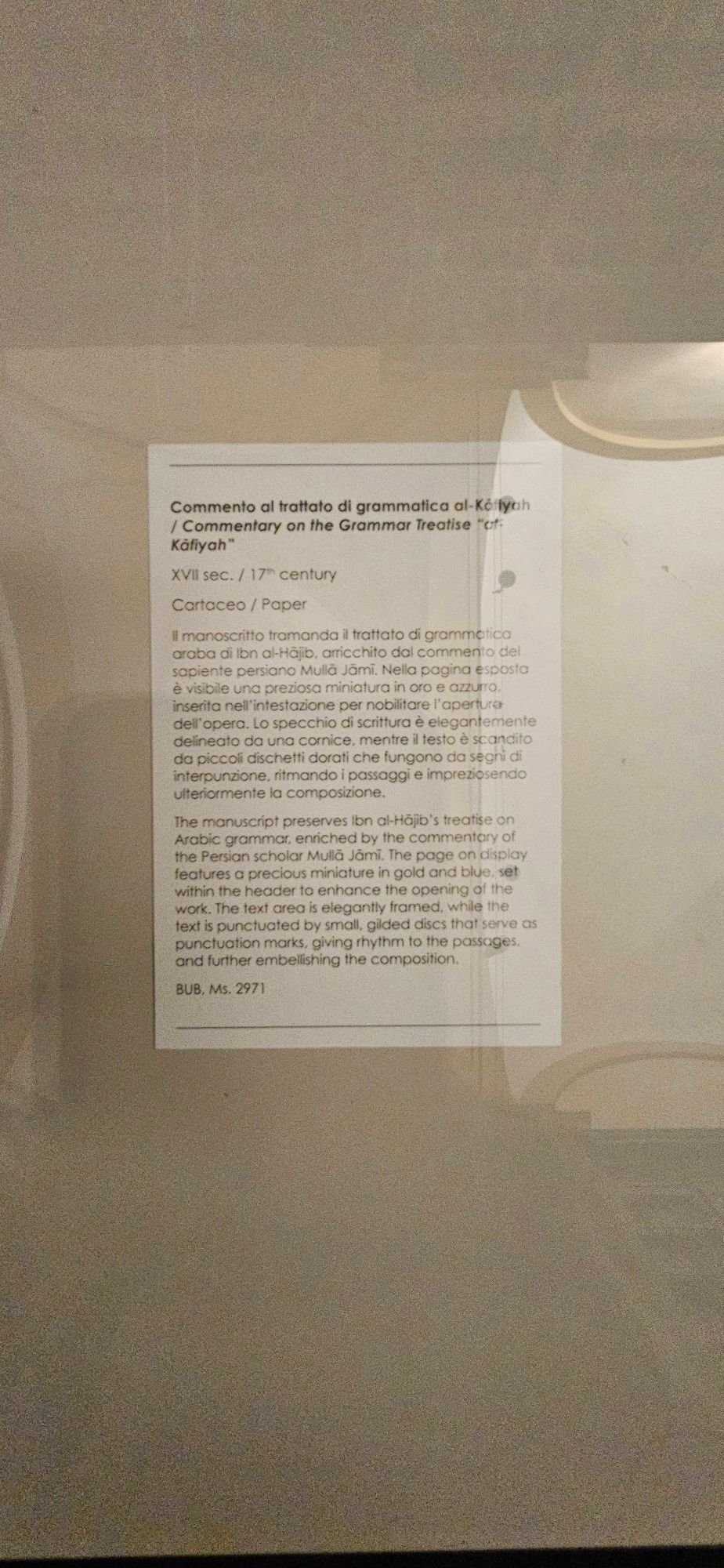
The third manuscript was a school book. The label reads Commento al trattato di grammatica al-Kāfiyah, seventeenth century: Ibn al-Ḥājib’s treatise on Arabic grammar, with the commentary of the Persian scholar Mullā Jāmī. The page on display opens with a small headpiece in gold and blue. The label points out the little gilded discs scattered through the lines, which work as punctuation marks, “giving rhythm to the passages”.
What the label doesn’t mention is the margins. The main text sits in a neat ruled frame. All around it, in every direction, at every angle, smaller hands have written notes: glosses, corrections, explanations squeezed diagonally into the corners. This was not a showpiece. It was a working textbook, and generations of students had argued with it in ink. That is what a grammar book looks like after it has actually been used.
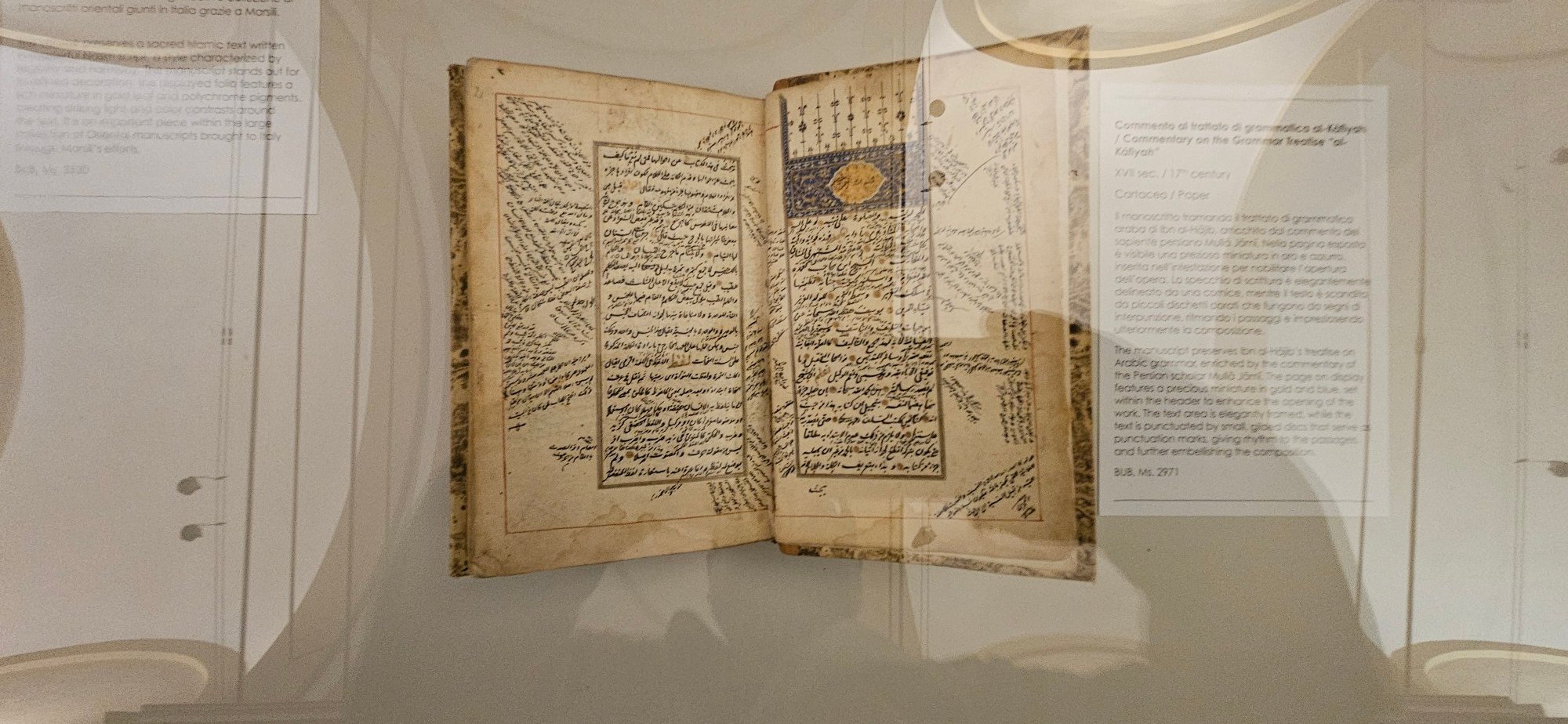 Ibn al-Ḥājib’s al-Kāfiyah with Jāmī’s commentary. A gold-and-blue headpiece, gilded disc punctuation, and margins full of later readers’ notes.
The Qur’an and the Armenian gospel
Further along was a seventeenth-century Qur’an (Al-Qur’ān al-Karīm, BUB Ms. 3520), written in naskh, which the label describes as a style “characterized by legibility and harmony”. The book lay open at its first pages. The text sits in a small central panel flanked by two tall panels of blue-and-gold geometric ornament, and the whole spread is crowned by scalloped gold arches with thin blue finials running out into the margin. The label calls it “an important piece within the large collection of Oriental manuscripts brought to Italy through Marsili’s efforts”. For a Muslim visitor it is an unusual sight: a mushaf lying open in a European university’s showcase, a long way from any mosque. Nearby was a very different book: an illuminated manuscript in Armenian script with gold clasps. On the left page, an evangelist with a halo holds a book while an angel stands at his shoulder. That is how Matthew is usually shown. On the right page, an ornamental headpiece of interlacing red and gold sits over the opening lines, a small angel stands beside the first letters, and a tall flowering ornament runs down the margin. I didn’t photograph its label, so I can’t say more about where it came from.
What I took away
Looking back at my photos, I’m in almost all of them: a dark silhouette reflected in the glass, phone raised, standing over the books. It is a fair picture of the visit. A Muslim visitor from Indonesia, in an Italian palace, bent over a Persian poem, an Arabic grammar and a Qur’an, collected by a Bolognese count who had once been a slave in the Ottoman camp.
Marsili’s institute was meant to gather all knowledge under one roof: astronomy, anatomy, natural history, military architecture. These manuscripts show that, for him, “all knowledge” included the learning of the world he had fought against and been captured by. He didn’t bring back trophies. He brought back grammar books with crowded margins, which is about the most honest record of scholarship there is.
Visiting: Museo di Palazzo Poggi, Via Zamboni 33, Bologna. The museum’s route now extends into the monumental rooms of the Biblioteca Universitaria di Bologna (BUB), which holds the Marsili manuscripts (“BUB, Ms.” on the labels). The astronomy museum (Museo della Specola) is in the same building, up in the tower.
Sources: exhibit labels at Palazzo Poggi (photographed above); University of Bologna: Luigi Ferdinando Marsili; Bologna Welcome: Biblioteca Universitaria; Bologna Welcome: Palazzo Poggi; Edward Worth Library: Marsili’s early life and military career; J. H. Elliott, “Drowning in the Danube”, review of John Stoye, Marsigli’s Europe 1680–1730 (London Review of Books, 1994).